Portuguese Punctuation Made Simple: A Practical Guide for Learners
Learn the most important punctuation rules in Brazilian Portuguese, including commas, periods, colons, semicolons, dashes, question marks and more, with clear examples.
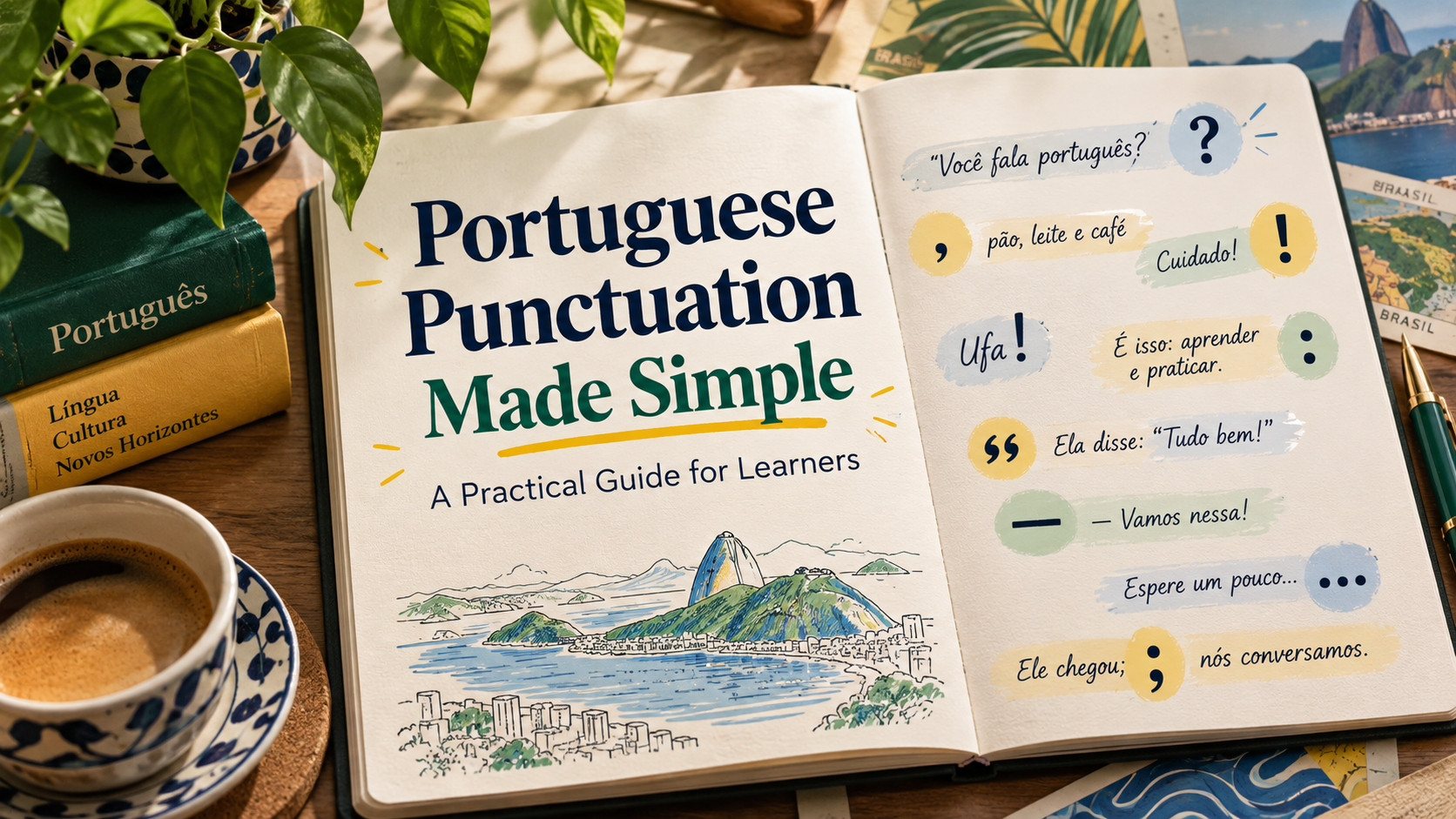
Learning vocabulary and verb conjugations is essential when studying Portuguese, but punctuation also plays an important role in making your writing clear and natural. Some punctuation rules are similar to English, while others may feel slightly different, especially when you begin writing longer sentences in Brazilian Portuguese.
In this guide, you will learn the most common punctuation marks used in Portuguese, with practical examples that you can immediately recognize and use.
The Period — Ponto Final
The ponto final (.) is used to finish a complete statement, just like the period in American English or the full stop in British English.
Eu moro no Brasil.
I live in Brazil.
Ela estuda português todos os dias.
She studies Portuguese every day.
It is one of the simplest punctuation marks, but using shorter, well-structured sentences is especially useful when you are still learning how Portuguese sentences are built.
The Comma — Vírgula
The vírgula (,) is one of the most important — and sometimes most confusing — punctuation marks in Portuguese.
It is frequently used to separate items in a list:
Comprei pão, leite, café e frutas.
I bought bread, milk, coffee and fruit.
It can also separate a word used to address someone directly:
Maria, você pode me ajudar?
Maria, can you help me?
You will also commonly see a comma before words such as mas:
Eu queria sair, mas estava cansado.
I wanted to go out, but I was tired.
One important rule for learners is that you normally should not place a comma between the subject and its verb.
Correct:
Meu irmão trabalha em São Paulo.
Not:
Meu irmão, trabalha em São Paulo.
This mistake is surprisingly common when learners try to reproduce the pauses they hear while speaking. Written punctuation, however, does not simply represent every pause in speech.
The Colon — Dois-Pontos
The dois-pontos (:) can introduce an explanation, a list, a consequence or a quotation.
Preciso comprar três coisas: pão, leite e café.
Here, the colon introduces an enumeration.
It can also introduce an explanation:
Meu maior objetivo é um só: falar português com confiança.
And it may introduce someone’s exact words:
A professora disse: “A prova será amanhã.”
Unlike English, you should not automatically capitalize the first word after a colon. Capitalization depends on what follows it.
The Semicolon — Ponto e Vírgula
The ponto e vírgula (;) creates a pause stronger than a comma but weaker than a period.
It can be useful when two related parts of a sentence are relatively long, particularly if commas already appear inside them.
Os alunos chegaram cedo; a professora, porém, ainda não estava na sala.
It is also frequently used in formal enumerations:
O curso tem três objetivos:
I — desenvolver a compreensão oral;
II — ampliar o vocabulário;
III — melhorar a comunicação.
You will probably use the semicolon less frequently than the comma, but learning to recognize it will make more formal Portuguese texts considerably easier to read.
The Question Mark — Ponto de Interrogação
The ponto de interrogação (?) marks a direct question.
Você fala português?
Do you speak Portuguese?
Onde você mora?
Where do you live?
Por que você está aprendendo português?
Why are you learning Portuguese?
Portuguese does not use an inverted question mark at the beginning of a sentence, as Spanish does.
The Exclamation Mark — Ponto de Exclamação
The ponto de exclamação (!) expresses emotion, surprise, enthusiasm, warnings or strong reactions.
Que lindo!
How beautiful!
Cuidado!
Be careful!
Finalmente!
Finally!
It is also very common with Brazilian interjections:
Ufa! — What a relief!
Eita! — Wow! / Oh my!
Nossa! — Wow!
These small expressions appear constantly in everyday Brazilian Portuguese and are strongly connected to tone and context.
The Dash — Travessão
The travessão (—) is longer than a hyphen and has several important uses in Portuguese.
One of its best-known functions is introducing dialogue:
— Você já terminou?
— Ainda não.
It can also isolate an additional comment inside a sentence:
O professor — sempre muito paciente — explicou tudo novamente.
In this function, the dash can sometimes perform a role similar to commas or parentheses while giving the inserted information more emphasis.
Quotation Marks — Aspas
Quotation marks are called aspas in Portuguese.
They can indicate direct quotations:
Ela disse: “Eu volto amanhã.”
They may also highlight words or expressions when discussing the words themselves:
The Portuguese word “saudade” is difficult to translate with a single English word.
In modern Brazilian texts, you may encounter both typographic quotation marks and simple straight quotation marks depending on the website, device or software being used.
Parentheses — Parênteses
Parênteses ( ) add supplementary information that is not essential to the main sentence.
Pedro nasceu em Recife (Pernambuco) e hoje mora em São Paulo.
The sentence would still make sense without the information inside the parentheses, but the additional detail provides useful context.
Ellipsis — Reticências
The three dots (...) are called reticências.
They can indicate hesitation, an unfinished thought or a sentence that intentionally trails off.
Eu não sei... talvez amanhã.
They are particularly common in informal conversations and messages because they can suggest emotion or hesitation that might otherwise be expressed through tone of voice.
Punctuation Can Change How Portuguese Sounds
Punctuation is not only about writing correctly. It helps the reader understand the rhythm, intention and structure of a sentence.
Compare:
Você vem.
This is a statement.
Você vem?
Now it is a question.
Você vem!
Depending on the context, this can sound like excitement, insistence or even an order.
The words are exactly the same, but punctuation changes how the message is interpreted.
Learn Portuguese Grammar Step by Step
You do not need to memorize every punctuation rule at once. Start by learning the marks you see most frequently, notice how Brazilians use them in real texts, and gradually add more complex structures to your writing.
At Fale Português, our Portuguese Grammar course includes practical lessons, examples and exercises designed specifically for people learning Brazilian Portuguese as a foreign language.
Instead of studying isolated rules, you can see how Portuguese actually works inside real sentences and learn to recognize the patterns naturally.
Continue learning Portuguese with Fale Português and discover new grammar lessons added regularly. 🇧🇷